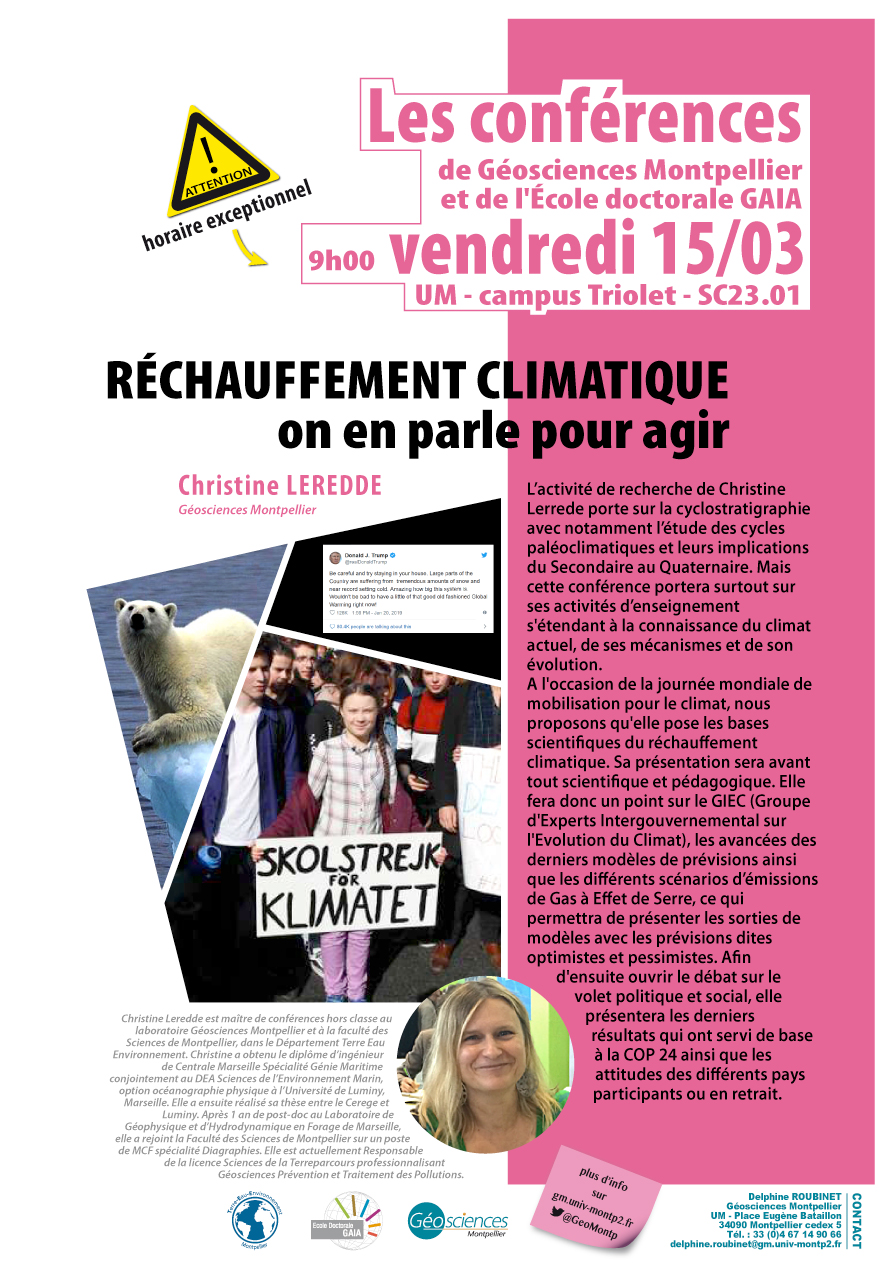
March 15, 2019 – Conference: Global Warming: Let’s Talk About It So We Can Take Action
Christine Leredde(Géosciences Montpellier)
Friday, March 15, 2019, at 9:00 a.m. (please note: this is a special time)
Triolet Campus, SC 23.01, Building 23, Triolet Campus, UM
Christine Lerrede’s research focuses on cyclostratigraphy, particularly the study of paleoclimatic cycles and their implications from the Mesozoic through the Quaternary. However, this lecture will focus primarily on her teaching activities, which encompass understanding the current climate, its mechanisms, and its evolution.
To mark Global Climate Action Day, we invite her to lay out the scientific foundations of global warming. Her presentation will be primarily scientific and educational. She will therefore provide an overview of the IPCC (Intergovernmental Panel on Climate Change), the advances in the latest predictive models, and the various greenhouse gas emission scenarios, which will allow her to present model outputs with both “optimistic” and “pessimistic” projections. To then open the discussion on the political and social aspects, she will present the latest findings that served as the basis for COP 24, as well as the stances of the various participating countries and those that have distanced themselves from the process.
Christine L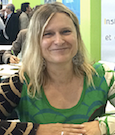 eredde is a senior associate professor at the Géosciences Montpellier laboratory and the Montpellier Faculty of Sciences, in the Earth, Water, and Environment Department. Christine earned an engineering degree from Centrale Marseille, specializing in Marine Engineering, along with a DEA (Master’s degree) in Marine Environmental Sciences, with a concentration in physical oceanography, from the University of Luminy in Marseille. She then completed her doctoral thesis jointly at Cerege and Luminy. After a one-year postdoctoral fellowship at the Laboratory of Geophysics and Hydrodynamics in Drilling in Marseille, she joined the Faculty of Sciences in Montpellier as a senior lecturer specializing in well logging. She is currently the program director for the bachelor’s degree in Earth Sciences, with a professional track in Geosciences: Pollution Prevention and Treatment.