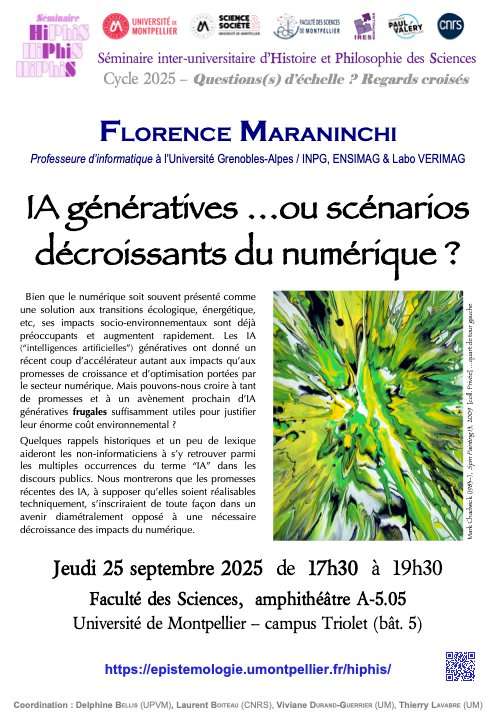
September 25 – HiPhis Conference: The Future of Digital Technology and (Generative) AI: A Brief Glossary, Missing Scenarios, and Bifurcations
Florence Maraninchi
Professor of Computer Science at the University of Grenoble-Alpes – INPG, ENSIMAG, and the VERIMAG Laboratory
Lecture Hall 5.05 – Triolet Campus
Abstract:
The digital sector as a whole already has very significant and rapidly growing environmental impacts; see, for example, the ADEME figures updated in January 2025. Furthermore, public discourse consistently presents digital technology as an essential part of the solution. There is talk of coupled digital, ecological, and energy transitions, of AI serving the environment, and so on. Research in computer science and digital engineering essentially follows two paths:
=> So-called Green-ICT approaches aim to reduce the environmental impacts of digital technology within its components themselves (hardware, software, communication infrastructure); this is where frugal AI comes into play.
=> So-called “Green-by-ICT” approaches aim to reduce the environmental impacts of another sector through the use of digital technology; examples include AI for agriculture, transportation, and smart buildings.
We argue that these two perspectives are woefully inadequate for understanding the role of digital technology (and AI in particular) in the face of the socio-environmental upheavals to come. Optimizations under the Green-ICT approach often (if not always) lead to massive rebound effects that negate the gains achieved in individual components. Green-by-ICT approaches are still merely promises. To comprehensively address the future of digital technology, we must consider scenarios in which the sector shrinks, as well as the resulting bifurcations.
Generative AI has recently accelerated both the impacts and the promise of digital technology. It has also shed light on certain aspects of the physical reality of digital technology, such as data centers and their water and electricity consumption.
In this presentation, we will begin with an overview of the socio-environmental impacts of digital technology as a whole. We will continue with some historical context and a brief glossary to help non-computer scientists navigate the frequent use of the term “AI” in public discourse. We will show that the recent promises of AI—assuming they are technically feasible—would in any case lead to a future diametrically opposed to the necessary reduction in the impacts of digital technology.
HiPhiS Contacts: Aurélie Zwang (aurelie.zwang@umontpellier.fr) / Delphine Bellis (delphine.bellis@univ-montp3.fr) / Laurent Boiteau (laurent.boiteau@umontpellier.fr) / Viviane Durand-Guerrier (viviane.durand-guerrier@umontpellier.fr)