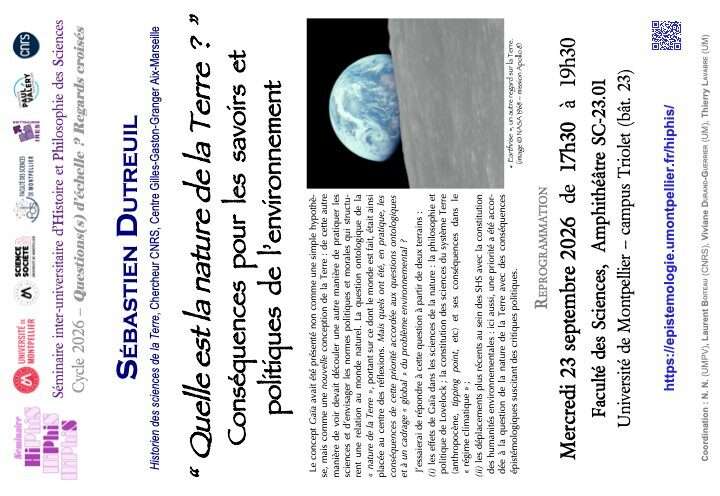
HiPhis Conference: “What Is the Nature of the Earth?”: Implications for Environmental Knowledge and Policy
Wednesday, September 23, 2026, from 5:30 p.m. to 7:30 p.m., UM Faculty of Sciences, Lecture Hall SC-23.01, free admission
(Building 23 – Triolet Campus), rescheduled from the session canceled on March 24
“What Is the Nature of the Earth?”: Implications for Environmental Knowledge and Policy
Sébastien Dutreuil
Historian of Earth and Environmental Sciences, CNRS Research Fellow at the Gilles-Gaston-Granger Center (CGGG), Aix-Marseille
Abstract:
The Gaia concept was presented not as a mere hypothesis, but as a new conception of the Earth: this alternative perspective was expected to give rise to a different approach to the practice of science and to the political and moral norms that shape our relationship with the natural world. The ontological question of the “nature of the Earth”—concerning what the world is made of—was thus placed at the center of these reflections. But what, in practice, were the consequences of this emphasis on ontological questions and a “global” framing of the environmental problem?
I will attempt to answer this question by examining two areas:
=> the impact of Gaia on the natural sciences: Lovelock’s philosophy and politics; the development of Earth system sciences (Anthropocene, tipping point, etc.) and its implications for the “climate regime”;
=> more recent shifts within the social sciences and humanities with the emergence of environmental humanities: here too, priority has been given to the question of the nature of the Earth, with epistemological implications that have sparked political criticism.
Bibliography:
□ Dutreuil, S. (2024), Gaia, the Living Earth: The Story of a New Concept of the Earth, Paris, La Découverte. ISBN 978-2-35925-140-1 | publisher’s link