Scientist of the Month – September 2026 (Sonia CANTEL): Decoding Metalloprotease Activity Through a Targeted Molecular Transfer Strategy

Meet Sonia Cantel, a professor in the Faculty of Sciences and a researcher atthe IBMM.
The ability to identify and track key molecular components—such as proteins, enzymes, and biomarkers—directly within a complex biological sample remains a major challenge for the early diagnosis of diseases, due to the low abundance of analytes, the complexity of biological samples, and the lack of selectivity in conventional approaches.
How can we address this issue?
To address this, we have developed AfBP (Affinity-based Probes) probes based on a proximity-induced label transfer mechanism: after specifically recognizing their target, these probes transfer a chemical tag to it, which can be directly detected by mass spectrometry.
It's like equipping only the suspects who are currently active in a crowd with badges, making it possible to locate and identify them all in a single analysis, without having to go through time-consuming processing steps first.

This is precisely the challenge we have taken on, in a context where the early identification of biomarkers of enzymatic activity remains a major obstacle to the diagnosis of many diseases. Here, this strategy is applied to matrix metalloproteinases, a family of enzymes whose dysregulation is closely associated with serious diseases such as cancer and inflammatory conditions. By incorporating a marker optimized for the exclusive detection of active enzymes and their precise quantification via MALDI mass spectrometry, this approach enables the accurate mapping of enzymatic activity directly within a raw biological sample, thereby paving the way for early, sensitive, and highly selective diagnosis.
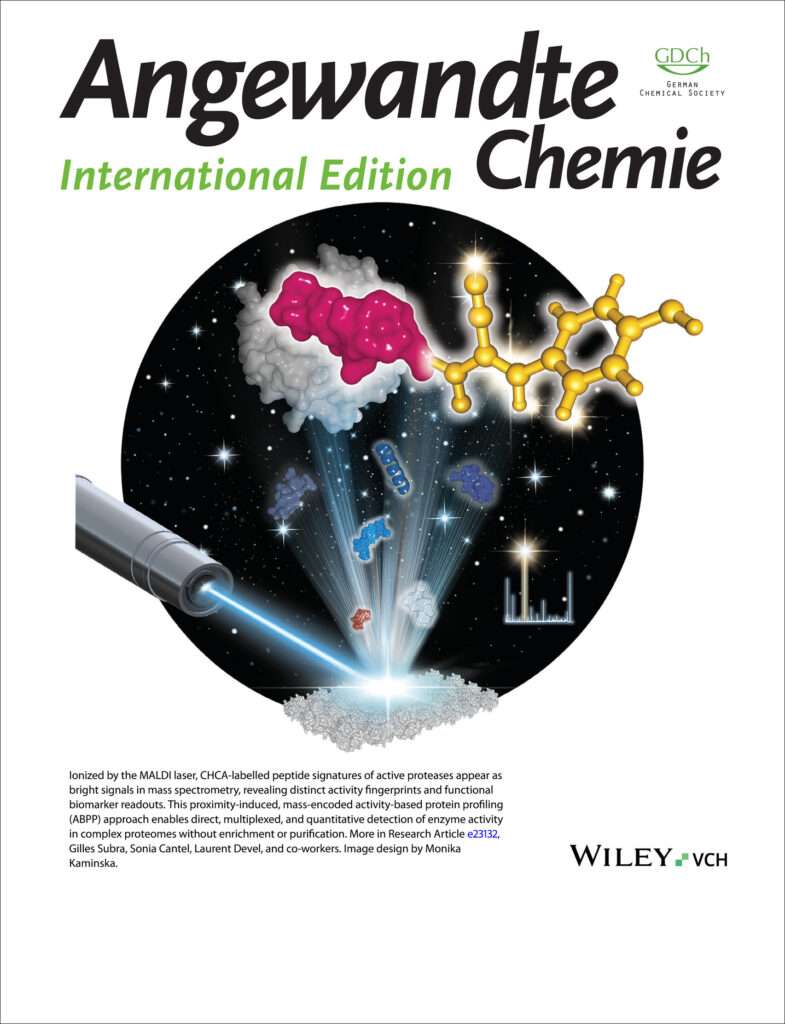
Article citation: “Proximity-Induced Transfer of a Mass Tag Enables Direct Profiling of Active Matrix Metalloproteases,” L. Berthy, U. Pasco, M. Sejalon-Cipolla, et al., Angewandte Chemie International Edition (2026): e23132.