Apprenticeship Contract
Important Information:
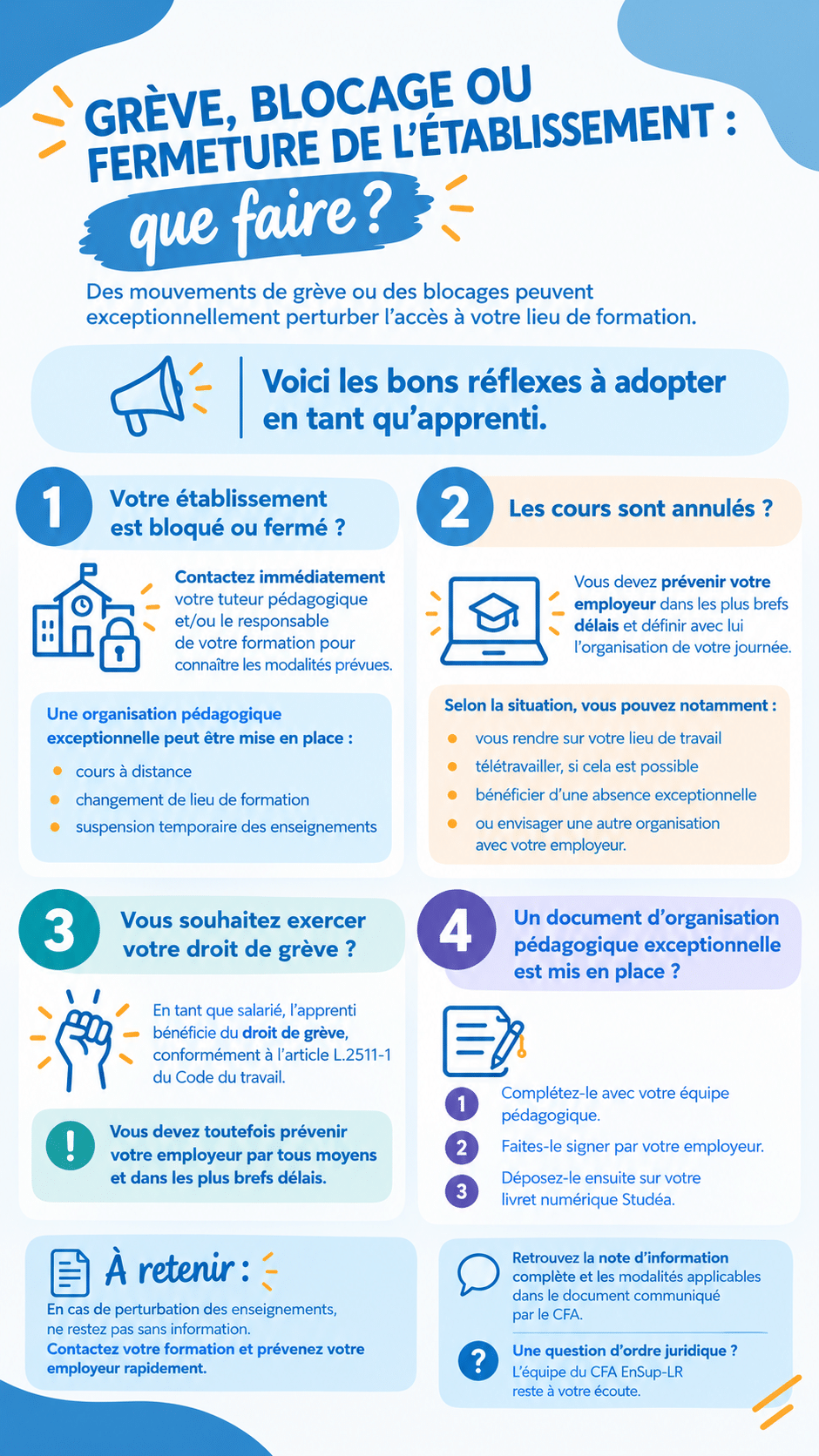
Campus Lockdown
In the event of disruptions to classes, here are a few important steps to take as an apprentice 👇
📌 Contact your training coordinator or academic advisor to find out the details.
📌 Notify your employer as soon as possible and work with them to plan your day.
📌 If you wish to exercise your right to strike, be sure to notify your employer as well.
📌 If a special educational arrangement is put in place, the document must be completed, signed by the employer, and then uploaded to your Studéa digital handbook.
Apprenticeships are based on the principle of alternating between theoretical instruction at an apprentice training center (CFA) and on-the-job training with the employer with whom the apprentice has signed a contract. Apprenticeship regulations are governed by the provisions of the Labor Code (Book II, Part 6).
Frequently Asked Questions
Apprenticeship Contract and Professional Training Contract: What Are the Differences?
The apprenticeship contract is a fully-fledged initial training program that allows young people to earn, under a specific employment contract, a technical or vocational diploma or certification listed in the National Directory of Professional Certifications (RNCP). It is open to young people aged 16 to 29.
The apprenticeship contract is a program designed to help individuals acquire a qualification recognized by a professional sector or listed in the RNCP, with the goal of rapid entry into the workforce. It may be available to individuals over the age of 26.
The legislative and legal framework differs between the two types of contracts: target audience, employer authorization, contract-related formalities, contract terms and duration, the young person’s compensation, benefits granted to the employer, training funding, and the sequence of contracts.
What are the requirements for enrolling in an apprenticeship program?
There are 4 of them:
- Be at least 16 years old and under 30 years old (no age limit in certain exceptional cases),
- Meet the eligibility requirements for the desired training program,
- Enter into an apprenticeship contract with an employer, after ensuring that the proposed position aligns with the requirements for the desired degree or certification,
- The requested training program must have enough openings to accommodate the apprentice.
Is apprenticeship training worth it?
No, this isa free training program for the work-study student, and it is paid since it is conducted under an employment contract.
How much will I be paid?
| Age of the apprentice | 1st year | 2nd year | 3rd year |
| Under 18 | 27% of the minimum wage | 39% of the minimum wage | 55% of the minimum wage |
| Ages 18 to 20 | 43% of the minimum wage | 51% of the minimum wage | 67% of the minimum wage |
| Ages 21 to 25 | 53% of the minimum wage | 61% of the minimum wage | 78% of the minimum wage |
| Over 26 years old | 100% of the minimum wage | 100% of the minimum wage | 100% of the minimum wage |
What is the principle behind learning?
Apprenticeships are based on the principle of alternating between academic and practical instruction provided at a training center and the acquisition of practical skills at an employer’s workplace.
The frequency of this alternation varies depending on the program but follows a schedule established in advance.
The apprenticeship contract is a special type of employment contract that allows the student to hold dual status: as a student and as a full-fledged employee of the company.
With which employer can you sign an apprenticeship contract?
Apprenticeships can be completed with any type of employer, whether private, public, or nonprofit:
Private-sector employers established or domiciled in France (mainland France and the overseas departments),
=> State, local government, and hospital public institutions,
=> Public industrial and commercial institutions (EPIC),
=> Temporary employment agencies,
=> Associations under the 1901 Law,
=> Employer groups,
=> Independent professionals.
How do I go about finding an employer?
The search for an employer is a key step for the future apprentice, as it positions them from the outset as an active participant in their training journey. This search is conducted using the same methods as a traditional job search: reviewing job postings, attending specialized forums and job fairs, searching online, reading the press, visiting Pôle Emploi, reaching out to companies and submitting unsolicited applications, and leveraging one’s professional network…
Well-written résumés and cover letters, thorough preparation for the job interview, and strong motivation will increase your chances of success.
Ideally, the process of looking for an employer should begin as early as March for a training program that starts in September.
Although it is preferable for candidates to take a proactive approach and find their own host company, the CFA EnSup-LR’s development department can advise you or assist you in this process, particularly by helping you prepare effective application materials (resumes, cover letters).
The CFA organizes workshops on corporate recruitment strategies and techniques.
At what point does one become an apprentice?
A young person acquires apprentice status on the day the apprenticeship contract is signed with the company. He or she becomes a full-fledged employee of the company and is entitled to the benefits applicable to all employees. Instructional time is included in the work schedule.
What are an apprentice's rights and responsibilities?
Apprentices are subject to the same working conditions as other employees of the company or government agency. The legal weekly workweek is 35 hours. Training time is considered working time. Apprentices are also entitled to paid time off, calculated in the same manner as for other employees of the company or government agency.Depending on the collective bargaining agreement, industry-wide agreements, or company-specific agreements, apprentices, like other employees, may be eligible for benefits such as a 13th-month bonus, health insurance, meal vouchers, etc. Finally, under an apprenticeship contract, apprentices make contributions toward retirement and unemployment insurance.
What should you do if you're absent?
Absences, whether during class periods or work placements, must be justified. Only authorized absences (e.g., illness, family matters) will be accepted by the CFA.
Learn more
Does the degree earned in this way have the same “value” as a degree earned through traditional means?
Absolutely. The curriculum and academic exam requirements are the same for all students, whether they are apprentices or not.
Apprenticeship training requires a significant personal investment and strong motivation. However, the added value of a degree earned through an apprenticeship, compared to one earned through a traditional academic program, lies in the acquisition of practical professional experience—a true ticket to employment that paves the way for rapid and successful entry into the workforce. An apprenticeship also helps develop skills in organization, independence,
What degrees can I earn through an apprenticeship?
Apprenticeships are available at all levels of education. The student must first meet the specific admission requirements for the chosen program, just as a student in a traditional program would.
When does the training begin?
Classes follow the same academic calendar as those in non-work-study programs and generally begin between September and November of each year, ending between May and August.
An apprenticeship contract may be signed within a 3-month period following the start date of the training program.
Is the work-study schedule the same for all programs?
No, this pace may vary depending on the course.
It is important to find out in advance about the work-study schedule for the program, as this can be a deciding factor for a future employer.
View the schedules
What kind of support is available for apprentices?
The CFA has launched a digital work-study handbook called STUDEA. It is a web-based tool that tracks the apprentice throughout the duration of their contract. Its purpose is to connect the apprentice, the academic advisor, and the apprenticeship supervisor. It serves as a meeting place, a platform for communication, and a record-keeping tool.
In particular, it allows users to verify the apprentice’s class attendance, exchange documents, and complete forms (placement reports, evaluation forms, reports, observations, etc.).
How do I prove I was present in class?
The apprentice must comply with the attendance requirements established for each training program (signing in or signing the attendance sheet).
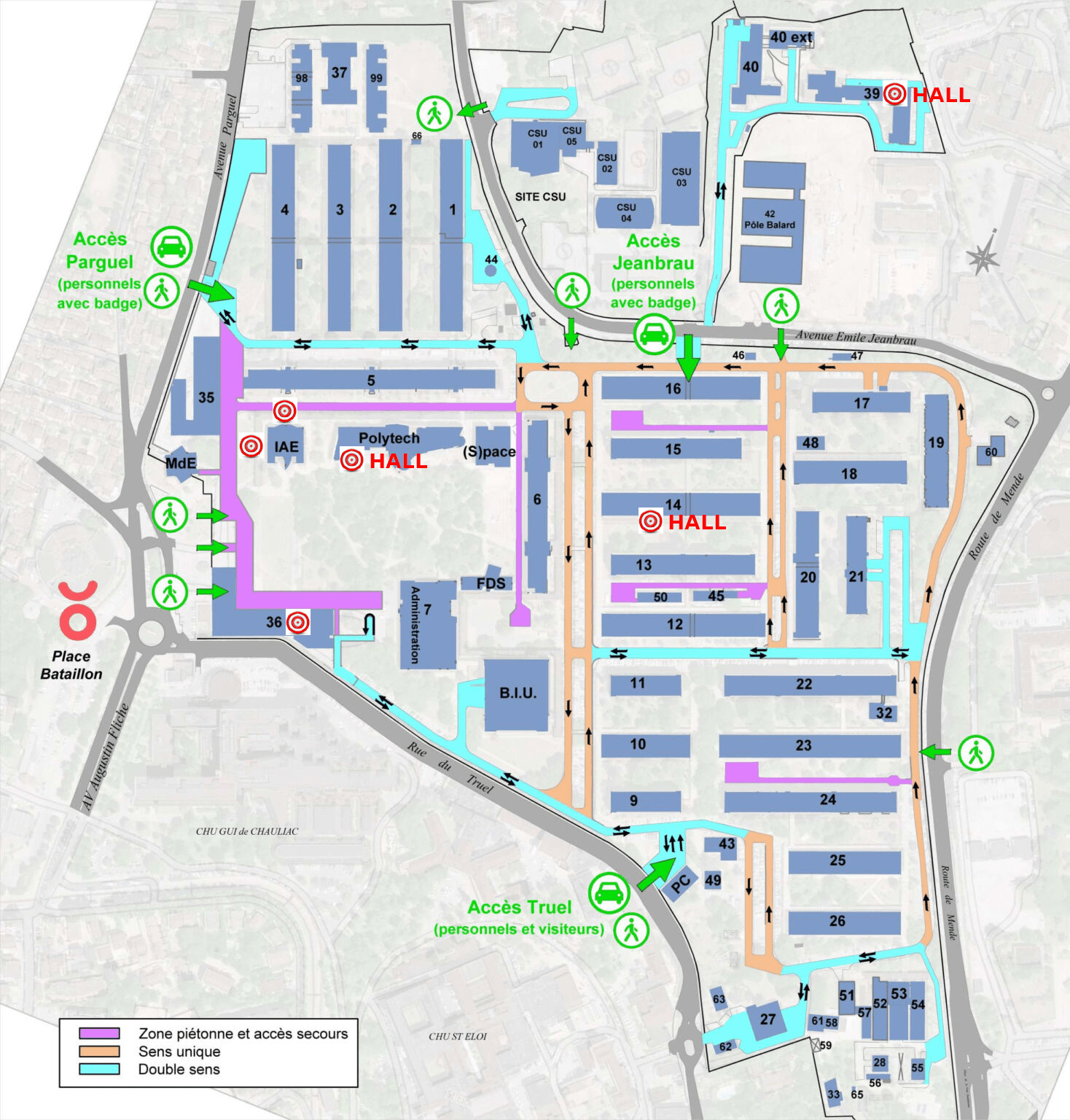
To that end, students must swipe their student ID cards—issued by the FdS upon registration—at the time clocks provided on campus.
Layout of the time clocks (See image below)
Attendance sheets, based on the CFA template, are also available to teaching staff in the following cases:
- If the time clock/ID card reader is not working;
- If the apprentice attends classes at another training location that is not equipped with a time clock, or outdoors as part of a field trip organized by the training program;
The apprentice must enter the attendance record—which has been countersigned by the teacher—into their digital work-study log (STUDEA).
Map of Time Clocks on Campus
Workshop on Corporate Research Strategies and Techniques
The CFA is organizing a workshop on strategies and techniques for finding companies
Prepare effective application materials to secure an apprenticeship contract.
Program:
– Overview of the terms of the apprenticeship contract;
– How to organize your job search
– Overview of the job market
– How and where to find information
– Tracking your job search
– Preparing application materials
– Resume
– Cover letter
– Job interview


I scan my ID card at
on campus to verify my attendance!
Click on the map (on the right) to see where the time clocks are located.
Testimonials from Our Apprenticeship Students
Sémy, a work-study student at CDPI
A collection of guides and documents to help you better understand learning

Are you a student at the university?
UM is committed to apprenticeships!
More than 180 programs open to apprentices, & 2,600 apprentices trained in 2021–2022!
Earn your BUT, Professional Bachelor’s, Master’s, or Engineering Degree through an apprenticeship